

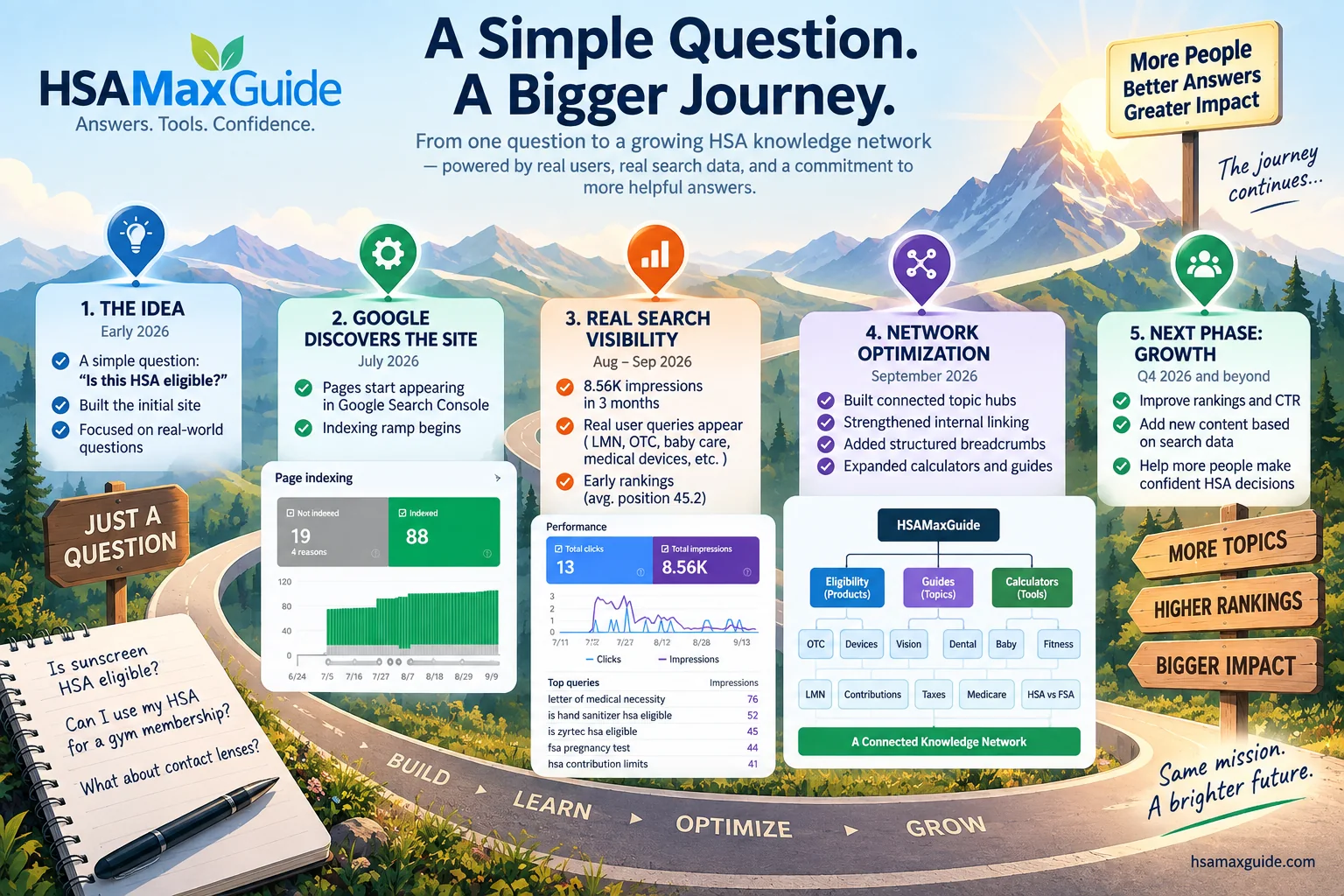
The first round of fixes was about cleaning up what Google could see. The next round was different. I stopped treating HSAMaxGuide as a collection of pages and started treating it as a network.
When I last wrote about it, the numbers weren't impressive: 8,739 impressions and 13 clicks between July 19 and September 23. That looks like a traffic problem, but it wasn't quite that simple. Some pages were already sitting near the bottom of page one, some queries were producing real impressions, and Google clearly knew the site existed. What was missing was a way for the site's information to work together.
So instead of publishing another batch of articles, I asked a different question.
What happens if I connect what I've already built?
That became the next HSAMaxGuide experiment.
From pages to a network
The original structure was simple. A visitor could search for an HSA-eligible expense, browse a category, read a guide, or use a calculator. That worked, but the relationships between those things weren't deep enough. Someone who found their answer didn't always see what to ask next.
Take allergy medicine. Each answer leads naturally to the next question:
- Is allergy medicine HSA eligible?
- Which allergy medicines?
- What are the HSA/FSA rules for OTC medicines?
- What other expenses qualify?
- Can I check another expense?
Those aren't five unrelated pages. They're one information journey.
The new structure
The HSAMaxGuide sitemap now lists 92 URLs, organized in layers. That number won't match the 102 pages in part two's link audit or the 108 URLs Search Console had discovered, because those count different things.
HSAMaxGuide
├── Eligibility
│   ├── Categories
│   └── Individual answers
├── Guides
│   └── Topic hubs (7)
└── Tools
    └── Calculators

Related questions link across all three branches.
The important addition wasn't another directory. It was the topic layer sitting between the individual pages and the rest of the site.
Seven topic hubs
Each hub gives a group of questions that already belonged together a common home.
1. HSA-Eligible Expenses
The broad eligibility network: OTC medicines, medical devices, vision, dental, first aid, baby and family expenses, skin care, and fitness and wellness.
2. Letters of Medical Necessity
A separate network for one of the more complicated areas of HSA eligibility: what a letter of medical necessity is, when it might matter, what it should contain, and which kinds of expenses may involve medical necessity.
3. HSA Contributions
Contribution limits, family rules, self-employed situations, and the contribution calculator now share a common home.
4. HSA vs. FSA
Instead of one comparison article, it becomes a pathway into eligibility, contributions, and reimbursement.



Illustrations for three of the seven hubs.
5. HSA Reimbursement
A home for reimbursement rules, documentation, and related questions.
6. HSA Tax by State
The 50-state reference and the individual state guides now sit inside a clearly defined tax network.
7. HSA After 65
A dedicated path for the questions that start appearing when Medicare and age 65 enter the picture.
Why I didn't create 100 more pages
This was probably the most important decision. Search Console had already shown Google producing impressions for questions about Zyrtec, Flonase, hand sanitizer, pregnancy tests, diapers, medical devices, contribution limits, and letters of medical necessity. That creates a temptation to build a page for everything: a Zyrtec page, a Flonase page, a Claritin page, an Allegra page, and on and on. Pretty soon you've built a large website without building a better one.
Can stronger relationships between existing pages produce more value than simply increasing the number of pages?
That's the experiment. It's the same principle behind the SEO site architecture framework: one destination for each intent, with related questions reinforcing it.
The network has to work in both directions
Before, a page pointed upward: Product → Category. Now I want something closer to Product → Category → Topic → Guide → Tool, and the relationship should work backward too. Contribution limits show how:
HSA Contribution Limits
        ↓
HSA Contributions hub
        ↓
Family contribution rules
        ↓
Self-employed HSA
        ↓
Contribution calculator
The calculator isn't a tool sitting alone in a /calculators/ folder anymore. It's a step in the visitor's journey.
Eligibility works the same way. For hand sanitizer, the useful journey isn't simply hand sanitizer, yes. It can run like this:
Hand sanitizer
        ↓
First aid & wound care
        ↓
HSA-eligible expenses
        ↓
Related first-aid products
        ↓
HSA/FSA guidance
        ↓
Eligibility checker
That gives the visitor somewhere useful to go after the original answer, and it gives the site stronger contextual relationships.
Search Console became a map
Once the network existed, I could look at HSAMaxGuide differently. Instead of asking what article should I write next?, I could ask a better question.
Which part of the network is Google already testing?
Search Console is effectively giving me that map. Some queries were already appearing at positions 8 to 13. That isn't traffic yet, but it is evidence that Google is willing to put some HSAMaxGuide pages near the first page for specific searches.
It changes the optimization question, too. It's no longer how to get Google to notice the site. It's what keeps a page sitting at position 9 from becoming the result someone actually clicks. That leads into titles, descriptions, search intent, relevance, internal links, and eventually authority. The title fixes in part two were the first move on exactly that question.
Expanding by evidence, not by calendar
Suppose Search Console starts showing Is Claritin HSA eligible? The old reaction would have been to create a Claritin page. The new reaction is to ask whether the Allergy Medicine page already answers that query.
- If it does, strengthen the existing page.
- If it doesn't, create the new one.
That's a more disciplined publishing system. Search data becomes the trigger, not a content calendar.
The hubs are live
The current sitemap contains the existing eligibility pages, categories, guides, and calculators, plus the new topics layer. This isn't a diagram of what I intend to build. It's live architecture.
What I'm watching now
- Impressions: does overall search visibility grow?
- Clicks: does additional visibility produce visits?
- CTR: do pages become more compelling in search results?
- Average position: do pages near page one move upward?
- Query breadth: does Google associate HSAMaxGuide with more relevant questions?
- Topic-hub visibility: do the new hubs themselves start receiving impressions?
- Page distribution: does visibility spread across the network, or concentrate on a handful of pages?
Those numbers will tell me whether the network did what I intended.
It might not work
That's part of why I'm documenting it. A better information architecture doesn't automatically produce rankings. Seven topic hubs don't automatically create authority, internal links don't automatically generate traffic, and a good diagram isn't evidence of SEO success. The only way to know is to measure what happens next.
Relationships, not volume
What changed wasn't the amount of information. It was the relationship between the information. A website can have 100 pages and still feel disconnected, while another with fewer pages makes the connections obvious. That's what I'm testing.
What I'd tell someone building a similar site
Don't start with how many articles you can publish. Start with which questions belong together, and build around those relationships: the individual answers, the category, the deeper guide, the tool, and the links between them. Then let search data tell you where the network needs another node.
The next question
The first experiment asked whether I could make the site technically clean enough for Google to understand. The second asks whether a connected network can turn that visibility into better rankings and more clicks. Part two ended on 13 clicks, a number that was useful because it forced me to stop treating impressions as traffic. This part ends on a different question.
What happens when the pages receiving those impressions are no longer isolated?
The architecture is in place. The hubs are live, and the eligibility pages, guides, and calculators are connected. Now comes the less glamorous part: waiting, measuring, and changing only what the data tells me to change. The answer isn't in the architecture diagram. It's in the next Search Console export.
A note on evidence: This post treats the network as an experiment. It doesn't claim the new architecture has improved rankings yet. The next Search Console measurement window will show whether it did.
To see the live site, visit HSAMaxGuide or go straight to its seven topic hubs.