

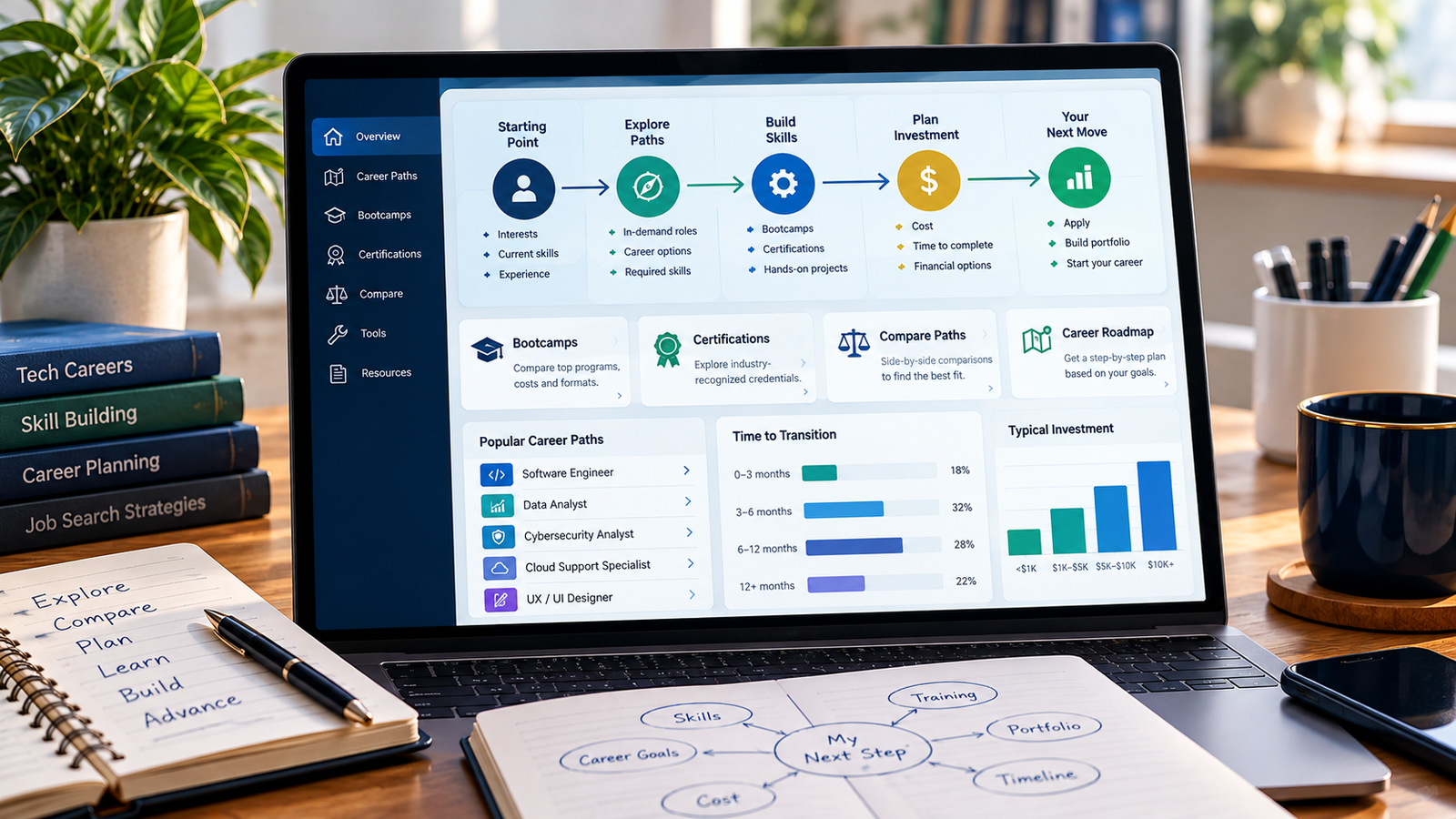
"Learn to code" is the easy part of the advice. Nobody follows it up with what actually matters: which path, which bootcamp, on what budget, in what timeline, starting from exactly where you are right now. That gap is the entire reason TechPathU exists.
A person can search for coding bootcamps. Then certifications. Then cybersecurity. Then cloud. Then IT support. Then salaries. Then training costs.
Very quickly, the research becomes a pile of disconnected tabs.
That was the problem I became increasingly interested in solving.
The real product wasn't another library of tech-career articles. It was the path connecting the articles.
The question changed
Instead of asking, “What information should TechPathU publish?” I started asking a different question:
What does a person actually need to know to move from where they are now to a realistic next step?
That changed the architecture.
The site became less like a magazine and more like a decision system.
From content categories to a connected career journey
TechPathU now brings several types of information into one broader journey rather than treating them as independent silos.
Career pathways
Different starting situations need different routes. A person with no experience does not face the same problem as someone already working in IT.
Certifications
Credentials become useful when they are placed in sequence and connected to the role or pathway they are intended to support.
Bootcamps
Bootcamps are treated as one possible route rather than the automatic answer. Cost, format, experience, and alternatives matter.
Comparisons
Side-by-side comparisons help a visitor understand tradeoffs before committing money or time.
The Pathway Finder became the central idea
The clearest expression of the new architecture was the Pathway Finder.
Instead of making someone assemble a career plan from dozens of articles, the system is designed around a few fundamental inputs: where the person is starting, where they want to go, and what they can realistically invest.
From there, the intended journey connects the pieces:
That is a fundamentally different experience from searching a site one article at a time.
The TechPathU homepage describes the same principle: the Pathway Finder asks about background, target lane, and realistic budget, then returns a sequence of certifications, cost range, timeline, and whether a bootcamp makes sense for that situation.
The important design lesson for me was that the tool didn't replace the content. It gave the content a job.
Different starting points change the answer
This became one of the most important distinctions in the project.
No experience
A true beginner may need foundational training and a different sequence of credentials and practice.
Adjacent field
Existing customer-service, process, business, or technical experience can change what needs to be learned and how it should be presented.
Already in IT
An existing IT role can change the pathway again, because the person may need a targeted next credential rather than a full career-change program.
Current TechPathU pathway reports reflect this structure. For example, its adjacent-field-to-IT-support pathway emphasizes transferable professional skills, while its IT-support-to-software-development pathway treats existing technical experience and scripting exposure as part of the starting advantage.
One of the biggest lessons: a recommendation needs context
Building TechPathU made me more skeptical of generic career advice.
“Get certified.”
“Join a bootcamp.”
“Learn to code.”
“Move into cybersecurity.”
Each statement can sound useful while still being incomplete.
The better question is: for whom, from what starting point, at what cost, and toward which role?
That principle now appears throughout TechPathU. Current pathway reports explicitly distinguish prerequisites, estimated cost, timeline, skills, recommended steps, roles, obstacles, and situations in which a pathway may not fit.
A career pathway isn't a universal prescription. It's a structured way to reason about a particular starting point and destination.
Building a comparison layer
Once the pathway architecture existed, comparisons became more useful.
Instead of presenting a long list of certifications or bootcamps, TechPathU could compare them around the variables that actually affect the decision: prerequisites, format, timeline, cost, role relevance, and what comes before or after the credential.
For example, the current IT-support certification comparison distinguishes A+, Google IT Support, Network+, and ITIL Foundation by starting point, typical timeline, and intended use rather than treating all certifications as interchangeable.
That reinforced another lesson:
Then there was the monetization problem
TechPathU also forced me to think about a tension that exists in many information businesses: what happens when the site can make money from the very products it is helping people evaluate?
Bootcamps, certification providers, and training companies can be affiliate relationships. That creates a legitimate reason to design the site carefully.
The system has to remain useful even when the best answer for a particular visitor is not to buy the thing that can generate revenue.
That is why the Pathway Finder's ability to say “skip the bootcamp” is important to the product philosophy. The current TechPathU homepage explicitly describes that behavior and discloses the site's bootcamp monetization relationship.
For me, this turned neutrality from an editorial statement into a UX problem.
If the architecture is genuinely decision-oriented, the system cannot quietly turn every journey into a sales funnel.
What the build taught me about information architecture
TechPathU made something obvious that is easy to miss when looking at a sitemap: the important thing isn't only how many pages exist. It is how the pages relate.
A certification page should know which careers it supports.
A career pathway should know which certifications belong in it.
A bootcamp comparison should connect back to the pathway where that bootcamp makes sense.
A calculator or quiz should lead somewhere useful after the result.
A visitor researching one career should have an obvious way to investigate adjacent careers without restarting the entire search.
That produces a network rather than a collection.
The build also exposed the difference between a tool and a page
One of the more interesting technical/product lessons was that an interactive tool only matters if the rest of the site can support it.
A quiz that produces a result but leaves the visitor nowhere to go is just another isolated page.
A pathway tool that produces a route connected to detailed explanations, comparisons, credentials, costs, and next steps becomes part of the site's information architecture.
That distinction matters for search as well as UX. The tool, the supporting pages, and the surrounding internal links have to form a coherent system.
What I learned from TechPathU
Information needs a destination.
A useful article should help a visitor understand what question comes next.
Context changes recommendations.
The same certification or training route can make sense for one starting point and not another.
Tools should connect to content.
Interactive features become much more valuable when their outputs lead into deeper pathways.
Comparisons should reduce uncertainty.
The point of a comparison is to clarify a decision, not create another research project.
Monetization changes the design.
Affiliate relationships make transparency and decision neutrality part of the UX.
Architecture is the product.
The connections among pathways, certifications, training, tools, and next steps create much of the site's value.
Where TechPathU goes from here
The next phase isn't simply adding another hundred career articles.
It is strengthening the network that already exists.
I want someone to be able to enter through almost any meaningful question and eventually reach a useful plan:
That is the larger experiment behind TechPathU.
Can a career-information website become something more useful: a system that helps a person understand where they are, compare realistic routes, and decide what to investigate next?
TechPathU is one of the projects where I'm trying to find out.
Observe what happens.
Learn from it.
Rebuild it.
Then do it again.
Explore the documented build and evolution on the TechPathU project page →