

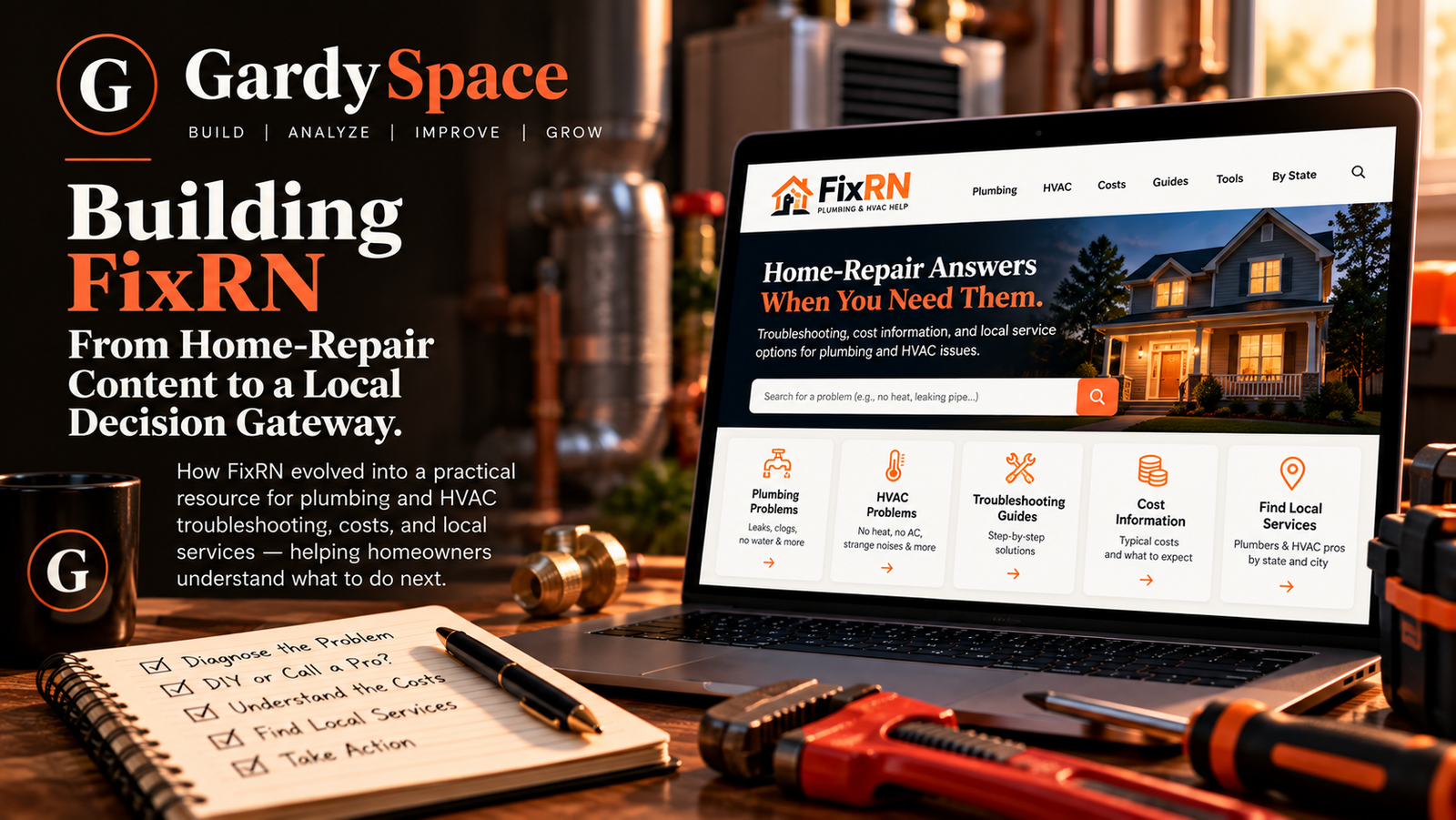
Nobody searches "why is my pipe leaking" because they're curious about plumbing. They search it because it's happening right now, water is somewhere it shouldn't be, and they have maybe ten minutes before they need to decide something.
That's the homeowner FixRN is actually built for. Not someone doing weekend research — someone standing in a hallway with a phone in one hand, trying to figure out if this is a "grab a towel" problem or a "call someone tonight" problem.
A burst pipe isn't just a plumbing-information query. An air conditioner that stops cooling isn't simply an HVAC topic. Both are "what do I do in the next ten minutes" problems wearing a search query as a disguise.
FixRN is not the contractor. It is a lead-generation and referral platform designed around education → trust → referral. The website's job is to help the homeowner understand the problem and reach the appropriate local resource.
1. The original problem was bigger than a local-service page
The obvious SEO model for a project like FixRN would be to build pages around searches such as “emergency plumber” and “emergency HVAC” combined with locations.
And those pages matter.
The September 17, 2026 sitemap shows state hubs for Arizona, Massachusetts, Pennsylvania, and Rhode Island, along with local emergency plumbing and HVAC pages across cities including Chandler, Scottsdale, Worcester, Springfield, Providence, New Bedford, Reading, and Pittsburgh.
But the local pages are only one part of the system.
The other part is the information layer: emergency guides, troubleshooting, cost information, and DIY-versus-professional decisions.
That became the foundation of the architecture.
2. The site evolved from “repair pages” into a gateway
As I worked through FixRN, I started seeing the site less as a contractor directory and more as a home-emergency gateway.
The gateway has multiple entrances.
Search entrance
A homeowner searches for a specific problem: burst pipe, no heat, leaking water heater, AC not cooling, sewage smell, or another urgent symptom.
Location entrance
A homeowner starts with a state or city and needs to understand which plumbing or HVAC services are relevant locally.
Both entrances can eventually lead into the same underlying decision model.
Problem → Diagnosis → Immediate action → Decision → Cost → Local resource.
That is much more scalable than treating every URL as an isolated landing page.
3. The sitemap showed the beginning of the system
The latest sitemap I was working from contains the core site, four state hubs, local emergency-service pages, two major guide hubs, and a substantial troubleshooting and cost layer.
The guide layer covers specific situations including burst pipes, frozen pipes, furnace failures, leaking water heaters, overflowing drains, no heat, refrigerant leaks, sump-pump failure, low water pressure, sewage smells, gas smells near water heaters, HVAC breaker problems, unusual HVAC smells, frozen AC coils, and other practical homeowner problems.
That breadth is important because it creates a bridge between informational search intent and local-service intent.
The local page should not have to do all the educational work. The guide network can answer the homeowner's immediate question and then connect that person to the appropriate local-service pathway.
4. Troubleshooting pages became more important than I expected
This was one of the biggest lessons from FixRN.
People do not always begin by searching for a contractor.
They often begin with a symptom.
“Why is my AC not cooling?”
“Why won't my furnace turn on?”
“What do I do about a burst pipe?”
“Why is my water heater leaking?”
Those queries are valuable because they reveal the homeowner's actual state of mind: something is wrong, and I need to understand it.
That makes troubleshooting content a natural first layer of the journey.
It can explain the problem, establish urgency, identify reasonable immediate steps, and then introduce the point at which professional help may be appropriate.
The referral CTA therefore becomes part of a useful journey rather than the entire purpose of the page.
5. The DIY-versus-professional question created a decision layer
Another recurring problem was the difference between “How do I fix this?” and “Should I fix this myself?”
Those are not the same question.
FixRN's sitemap includes dedicated DIY-versus-professional guides for both plumbing and HVAC. That is significant because the website is not simply trying to push every visitor toward a contractor.
Instead, the information architecture can acknowledge that different problems call for different responses.
Understand
Explain the symptom, common causes, urgency, and relevant considerations.
Decide
Help the homeowner determine whether the situation calls for immediate professional attention or another appropriate next step.
That is where the “decision assistance” concept became central to the project.
6. Cost information adds another dimension
Once a homeowner realizes professional help may be needed, another question appears almost immediately:
“What is this going to cost?”
FixRN's architecture includes emergency plumber cost and emergency HVAC repair cost pages organized around the job or problem.
That gives the site another useful layer between diagnosis and referral.
The visitor can move from:
What is happening? → What should I do? → What might the repair involve? → What cost factors should I understand? → Where can I find local help?
Again, the point is not to promise an exact price from a generic web page. The point is to reduce uncertainty before the homeowner takes the next step.
7. Local SEO became distribution, not the whole product
The local architecture is still important.
The sitemap contains four state hubs — Arizona, Massachusetts, Pennsylvania, and Rhode Island — with city-level emergency plumbing and HVAC pages beneath them.
That creates a geographic structure:
But I became more cautious about the relationship between local pages and useful content.
A large set of location pages can become repetitive if every page says essentially the same thing with a different city name. The more interesting architecture is one where local pages are supported by genuinely useful guides and where each URL has a clear role in the broader journey.
That became an important design principle for FixRN:
Do not build a city-page machine. Build a decision system that happens to have geographic distribution.
8. This changed how I think about internal linking
Once the site had both local pages and educational guides, internal linking stopped being a simple SEO exercise.
It became navigation between states of the homeowner's problem.
A troubleshooting guide can connect to an emergency guide. The emergency guide can connect to a cost page. The cost page can connect to a relevant local service. A state hub can connect back into the guide network. A city page can point toward information that helps the visitor understand what service they may actually need.
That creates a graph rather than a stack of pages.
The goal is not simply to make pages link to each other. The goal is to make the next link feel like the logical next question.
9. FixRN taught me the difference between traffic and utility
One of the easiest traps in local SEO is thinking only about the query.
Someone searches “emergency plumber Worcester.” You build the page. The keyword is covered.
But what happens next?
Does the page help the visitor determine whether the problem is actually plumbing? Does it explain what information they should have ready? Does it help them understand urgency? Does it connect to cost context? Does it make the local referral meaningful?
Those questions are where utility begins.
That is why the broader FixRN model became:
SEO → useful information → decision assistance → local provider action.
That sequence is much more interesting to build than a collection of pages designed only to capture search traffic.
10. The project also forced me to think about scale
FixRN is deliberately broader than a single home-repair problem.
The underlying model can support plumbing and HVAC now while creating a framework that can expand into other emergency home systems later.
The important part is that the expansion should preserve the same decision model.
Different problem
The homeowner may have a different system, symptom, urgency, or repair question.
Same architecture
The site can still move from problem → diagnosis → immediate action → decision → cost → local resource.
That is the difference between adding another category and extending a platform model.
11. The biggest architectural risk became obvious
The more local and service-specific the site becomes, the easier it is to produce pages that look useful structurally but offer little unique value individually.
That is why the next stage of FixRN is not simply “publish more city pages.”
The stronger direction is to make each part of the network do a distinct job:
- State hubs organize geographic coverage.
- Local pages serve high-intent service/location discovery.
- Guide hubs organize the knowledge layer.
- Troubleshooting guides answer specific homeowner problems.
- Cost pages help visitors understand planning and uncertainty.
- DIY/pro guides support the decision itself.
- Referral pathways provide the commercial next step.
When each layer has a clear purpose, the architecture becomes much harder to confuse with a collection of templated landing pages.
12. What FixRN taught me
Local SEO is only the distribution layer.
The real product is the useful journey that happens before and around the local-service action.
Symptoms can be better entry points than services.
Homeowners often search because something is wrong, not because they have already identified the exact professional service they need.
Education creates trust before referral.
Because FixRN is a referral platform rather than the service provider, useful information is part of the product rather than decoration around a lead form.
Cost information belongs inside the journey.
Price uncertainty is part of the homeowner's decision, so cost guidance can bridge diagnosis and local action.
Internal links should follow user intent.
The best next link is usually the page that answers the next question the visitor is likely to have.
Scaling means preserving the model.
New systems and locations should extend the same decision-support architecture rather than simply multiplying similar pages.
13. Where I would take FixRN next
The next phase is about strengthening the connections rather than simply increasing the number of URLs.
I want FixRN to make the homeowner journey increasingly clear:
That means strengthening guide-to-local relationships, making local pages genuinely useful, improving decision trees and practical tools, and expanding carefully into additional home systems without losing the common architecture.
The goal is not to become another contractor website.
It's to be the thing that turns "something is wrong with my home" into "okay, I know what to do in the next ten minutes" — the same gap I started with, just answered instead of just described.
FixRN started as home-repair searches. The more interesting product turned out to be the ten minutes of panic behind those searches.
That's the part I keep relearning across these builds: the site isn't the contractor, and it isn't just a publisher either. It's whatever sits in between "something's wrong" and "I know what to do" — and that middle ground is more interesting to build for than either end of it.
Explore the documented build and evolution on the FixRN project page →